For my open topic blog, I decided to focus on binaural beats and the science behind it. Throughout this unit, working on immersive and spatial audio was a practice that truly intrigued me since it was a new experience for me and is one thing I believe I can incorporate into my future production.
When two slightly different frequencies are simultaneously presented to each ear, an auditory illusion known as binaural beats is produced. This causes the brain to perceive a third tone, which is thought to influence brainwave activity and possibly induce focus and relaxation while also lowering anxiety. This third tone is calculated by the difference between the two tones, for example, if you are listening to a 444 Hz tone in one ear and a 440 Hz tone in the other, you will hear a 4 Hz tone. Studies show that lower frequencies (4-8 Hz) are linked to meditation and creativity, while higher frequencies (14-30 Hz) are associated with focused attention and increased energy.
The superior olivary complex, which is found in the brain stem, is the first area of the brain to process sound from both ears. It creates a binaural beat in response to two close frequencies and aids in synchronizing the activity of numerous neurons in your brain. The process of synchronization is called entrainment. Entrainment doesn’t only relate to music, it is also used in various fields such as psychology in order to illustrate the rhythmic activities of the brain dependent on the physical environment. In relation to this, your brain actively follows the frequency of the beat, called the ‘frequency-following effect’.
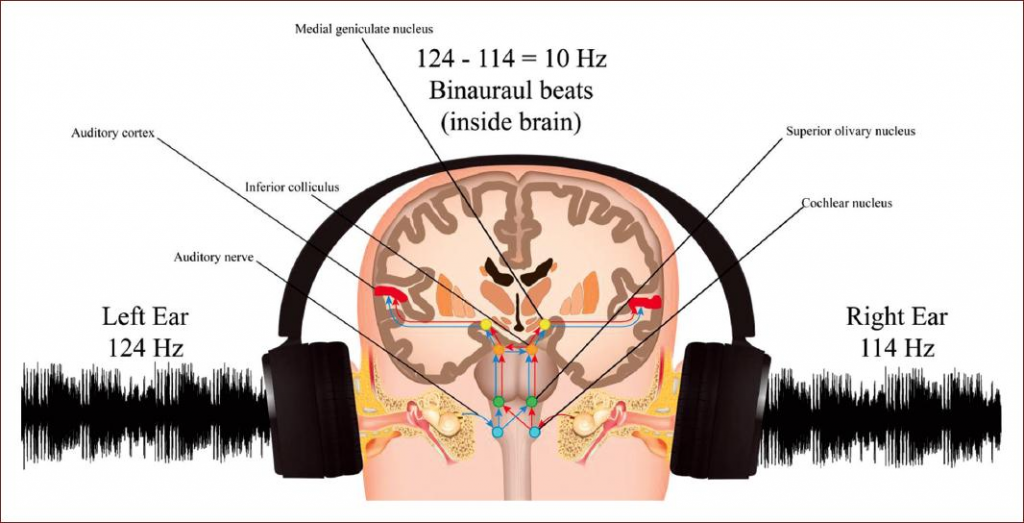
A study from 2017 further highlights the effects of binaural beats on the brain, as a researcher displayed that using delta waves (associated with sleep) on pre-operative patients was highly effective in reducing pain and anxiety levels. It was said that it was just as effective as opioids in anesthesia, compared to patients with no binaural audio. Additionally, a study conducted by Sung et al showed that individuals who listened to binaural beats for five consecutive days had a notable reduction in sympathetic nervous system activity, along with a significant increase in parasympathetic nervous system activity. This further implies that binaural beats has the potential to alter anxiety and stress levels, as well as boost feelings of calmness and relaxation.
Morgan, K. (2021). What Are Binaural Beats? [online] WebMD. Available at: https://www.webmd.com/balance/what-are-binaural-beats [Accessed 22 May 2025].
researchgate.net. (2007). A pilot study comparing reduction of anxiety by binaural beat audio and patient‐selected music in the pre‐operative period. [online] Available at: https://www.researchgate.net/publication/230106777_A_pilot_study_comparing_reduction_of_anxiety_by_binaural_beat_audio_and_patient-selected_music_in_the_pre-operative_period [Accessed 22 May 2025].
researchgate.net. (2017). Familiar Music Listening with Binaural Beats for Older People with Depressive Symptoms in Retirement Homes. [online] Available at: https://www.researchgate.net/publication/321245985_Familiar_Music_Listening_with_Binaural_Beats_for_Older_People_with_Depressive_Symptoms_in_Retirement_Homes [Accessed 22 May 2025].